
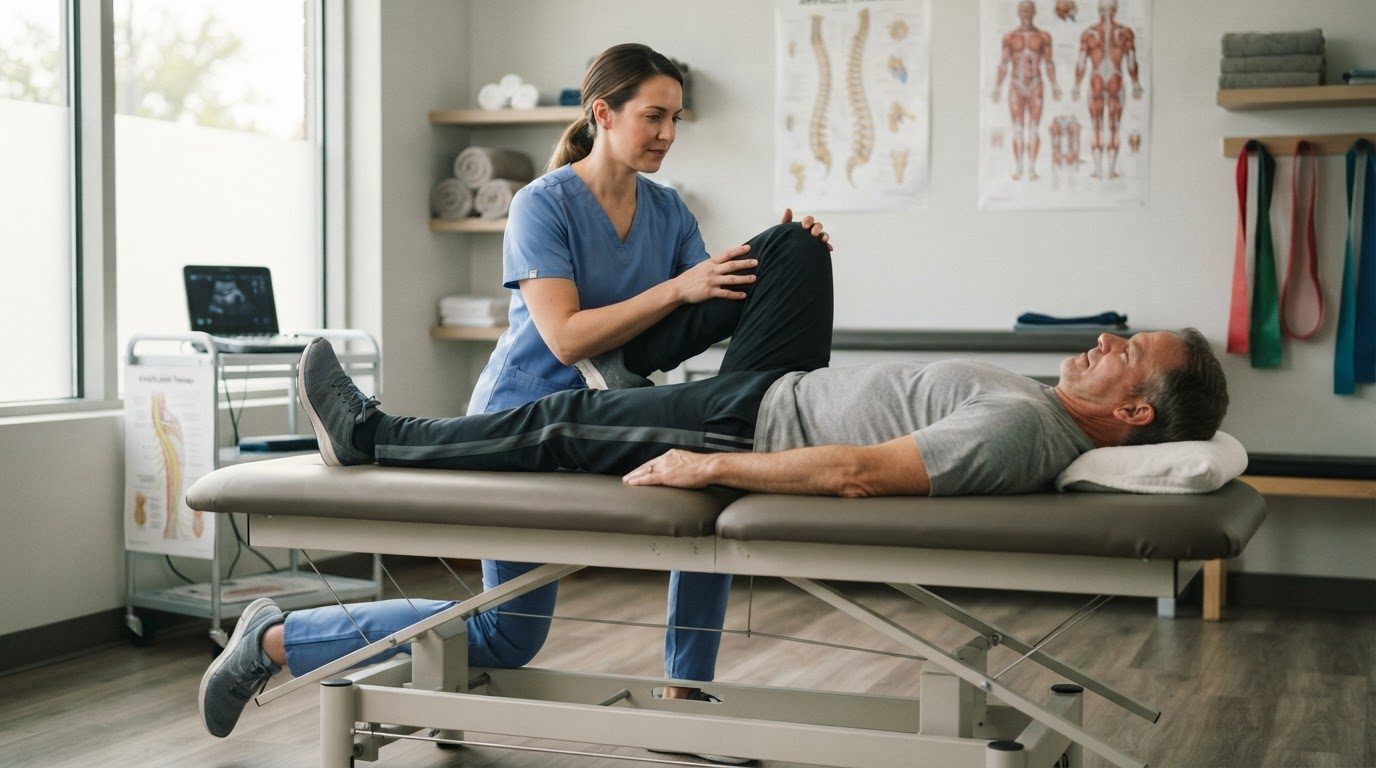
Pain that shoots from your lower back into your buttock or leg is not always “just a bad back.” Sciatica usually involves irritation or compression of the sciatic nerve or one of the nerve roots that forms it. That distinction matters because prolonged rest, repeated stretching, or treating only the painful leg may not address what is driving the problem.
The right Sciatica treatment depends on the pattern of your symptoms, how you move, and whether the nerve is being affected by a disc, narrowed spinal space, joint restriction, or irritated soft tissue. Mild episodes often improve with conservative care, but worsening weakness or changes in bladder or bowel control require urgent medical attention.
At True Health Chiropractic and Acupuncture, care focuses on examining how your body moves and building a plan around your work, daily activities, and goals. The practice describes using chiropractic care and acupuncture, including flexion-distraction, cold laser, and electrical stimulation for appropriate patients in Lombard, Illinois.
First, determine whether the symptoms fit sciatica
Sciatica commonly travels from the lower back or buttock down one leg, often extending below the knee. The sensation may be sharp, burning, shooting, or electrical. Numbness, tingling, and weakness can occur in the leg or foot.
Back pain without radiating leg symptoms is more likely to involve another structure, although only an examination can sort out the cause reliably. Hip problems often produce pain in the groin or pain with weight-bearing, while sciatic nerve pain more often begins near the lower back and follows the back or side of the leg.
Common causes include:
- A herniated or bulging disc pressing on a nerve root.
- Spinal stenosis, in which narrowed spaces place pressure on spinal nerves.
- Restricted movement in spinal or pelvic joints.
- Muscle irritation, including symptoms associated with piriformis syndrome.
- Sacroiliac joint dysfunction or another source of referred pain.
Sciatica usually affects one side. Symptoms in both legs, rapidly progressing weakness, or significant loss of sensation need prompt professional evaluation.
What to do during the first few days
Complete bed rest is rarely the best approach. Short periods of rest can be reasonable during a severe flare, but staying still for too long often increases stiffness and slows the return to normal movement. Change positions regularly and take brief, easy walks if they do not intensify your symptoms.
Cold or heat can provide short-term comfort. A cold pack wrapped in a cloth may help during the early, more inflamed phase. Heat can relax tight muscles after that or whenever muscle stiffness is a major part of the discomfort. Limit either application to roughly 15–20 minutes and protect your skin.
Gentle movement is useful only if it stays within a tolerable range. Stop an exercise that causes stronger leg pain, increasing numbness, or new weakness. A stretch that feels helpful for one person may aggravate a compressed nerve in another.
Over-the-counter pain relievers, including nonsteroidal anti-inflammatory drugs such as ibuprofen or naproxen, are not appropriate for everyone. People with a history of ulcers or gastrointestinal bleeding, kidney disease, certain cardiovascular conditions, medication interactions, or pregnancy should ask a qualified clinician before using them. Follow the product label and do not combine medicines without checking for duplicate ingredients.
Why repeated stretching does not always solve the problem
Stretching can ease stiffness, but it is not a universal treatment for nerve pain. If a disc or narrowed spinal canal is irritating a nerve root, aggressively stretching the hamstrings, hips, or lower back may reproduce the symptoms rather than resolve them.
The same applies to “pushing through” pain. A temporary reduction in symptoms does not necessarily mean the underlying irritation has settled. Pay attention to whether the pain is moving farther down the leg, becoming more intense, or being joined by numbness and weakness.
A more useful assessment asks:
- Which movements increase or reduce the leg pain?
- Does sitting, standing, walking, bending, or driving change the symptoms?
- Is the problem primarily in the back, buttock, or leg?
- Has strength changed when lifting the foot, climbing stairs, or walking?
- Are symptoms improving, stable, or progressing?
Those answers help a clinician decide whether self-care is reasonable or whether an examination and targeted treatment are warranted.
What an evaluation should include
A proper evaluation begins with your history: when the pain started, how far it travels, what triggers it, and whether you have experienced numbness or weakness. A physical examination may assess posture, spinal and hip movement, reflexes, sensation, muscle strength, and walking.
Imaging is not automatically needed for every new episode. Clinicians commonly reserve X-rays, MRI, or other testing for situations involving severe or worsening symptoms, neurological findings, trauma, suspected serious disease, or symptoms that fail to improve with initial care. The appropriate test depends on the suspected cause.
At True Health, the first visit is described as an opportunity to listen to your concerns, assess how your body moves, identify the likely source of irritation, and explain what to do next. That type of assessment is particularly relevant when leg pain keeps returning after temporary relief.
Conservative treatment options
Most sciatica treatment begins without surgery. The goal is to reduce irritation while restoring useful movement and helping you resume normal activities safely.
Chiropractic care
Chiropractic treatment may include manual techniques, mobilization, and exercise guidance designed to improve spinal or pelvic movement. True Health specifically describes flexion-distraction as a technique intended to decompress the spine without forceful manipulation.
Treatment should be adapted to the suspected cause and your neurological findings. A practitioner should not continue a technique that clearly worsens radiating pain, numbness, or weakness. Tell every clinician about osteoporosis, recent trauma, cancer history, infection risk, blood-thinning medication, or other significant medical conditions before treatment.
Acupuncture
Acupuncture may be used as part of a broader plan for pain management and movement. It should not replace evaluation of progressive nerve weakness or other red-flag symptoms. Discuss acupuncture with a qualified provider if you have a bleeding disorder, use anticoagulants, are pregnant, or have concerns about infection and skin integrity.
Physical therapy and home exercises
A physical therapist can teach movements that match your symptoms rather than relying on a generic stretching routine. Programs may address trunk and hip strength, mobility, walking tolerance, posture, and the mechanics of work or exercise.
Progress should be gradual. The aim is not to force the spine into a particular position; it is to find movements that reduce sensitivity and improve function over time.
Medication, injections, and surgery
A medical clinician may recommend prescription medication when pain is severe or persistent. An epidural steroid injection is sometimes considered for ongoing nerve-root pain, particularly when conservative measures have not provided enough relief.
Surgery is generally reserved for selected cases, such as persistent disabling pain linked to a correctable compression, progressive neurological loss, or serious symptoms that do not respond to other treatment. It is not the automatic next step for ordinary sciatica.
When sciatica needs urgent care
Seek emergency medical evaluation for:
- New loss of bladder or bowel control.
- Numbness around the groin or inner thighs.
- Severe or rapidly worsening weakness in a leg.
- Symptoms affecting both legs with significant neurological changes.
- Back or leg pain after major trauma, especially with weakness or loss of sensation.
Contact a healthcare professional promptly if pain is worsening, numbness is spreading, walking is becoming difficult, or symptoms are not improving after a few weeks. Persistent pain deserves a clearer diagnosis rather than repeated cycles of rest and flare-ups.
How long recovery usually takes
Many uncomplicated episodes improve within several weeks, and many people recover without surgery. The timeline depends on the cause, severity, nerve involvement, general health, and how the condition responds to treatment.
Improvement is not always linear. A good sign is steadily increasing tolerance for walking, sitting, sleeping, or working. A concerning pattern is pain that travels farther down the leg, increasing tingling, or declining strength—even if the overall pain briefly fluctuates.
Practical ways to reduce future flare-ups
Once symptoms settle, prevention focuses on maintaining capacity rather than avoiding all movement. Build activity gradually, strengthen the trunk and hips under appropriate guidance, use supportive positioning during prolonged sitting, and take movement breaks during desk work or driving.
Avoid lifting with a rounded back and twisting under load. Use a controlled hip-and-knee bend instead, keep the load close, and ask for help when it is too heavy or awkward. If a particular exercise repeatedly sends pain below the knee, stop and have it assessed rather than repeatedly testing it.
Sciatica treatment works best when it matches the actual source of irritation. If pain keeps returning, spreads down the leg, or affects strength and sensation, an in-person evaluation can determine whether conservative care is appropriate and whether additional medical assessment is needed.
